

Warehouse operations involve much more than storing and moving products. Teams need to receive goods, assign storage locations, track inventory, pick orders, pack shipments and maintain accurate records across every stage. As order volumes increase and supply chains become more connected, manual processes can make it harder to maintain inventory accuracy, control operating costs and fulfill orders on time. A Warehouse Management System (WMS) brings these activities together through a centralized digital platform.
A modern WMS helps businesses manage inventory in real time, automate warehouse workflows, improve picking accuracy and connect warehouse operations with ERP, logistics and other business systems.
In this article, we explore 8 key benefits of a Warehouse Management System and how WMS software can help businesses improve warehouse efficiency, inventory control and order fulfillment.
What Does a Warehouse Management System Do?
A Warehouse Management System (WMS) is a software that manages and controls warehouse operations from receiving through dispatch.
Typical WMS functions include:
- Inventory tracking and stock management
- Receiving and putaway
- Location management
- Picking and packing
- Order fulfillment
- Stock transfers and cycle counting
- Replenishment
- Barcode and RFID scanning
- Warehouse reporting and analytics
- ERP and third-party system integration
- Warehouse automation
A WMS connects these processes so warehouse teams can work with accurate inventory information and follow defined workflows. PALMS™ Smart WMS, for example, supports receiving, dispatch, inventory, stock transfers, cycle counting and handheld terminal operations.
8 Key Benefits of a Warehouse Management System

1. Improved Inventory Accuracy
Inventory accuracy is essential for efficient warehouse operations. When stock records do not match physical inventory, businesses can face stockouts, excess inventory, picking errors and delayed orders.
A WMS records inventory transactions as goods move through the warehouse. Barcode scanners, RFID and handheld devices can be used to validate products, quantities and locations during receiving, putaway, picking and dispatch. This gives warehouse teams a more reliable view of what is available and where it is stored.
PALMS™ provides real-time inventory information along with tracking for attributes such as batch numbers, manufacturing dates, serial numbers and expiry dates.
2. Real-Time Warehouse Visibility
Knowing the quantity of stock is useful. Knowing where the stock is, how it moved and what is happening to an order provides much greater operational control.
A WMS creates a centralized view of inventory, warehouse locations and order activity. Managers can monitor stock movements and warehouse processes without relying entirely on spreadsheets or manual reports. Real-time visibility also helps businesses respond faster to changes in demand, inventory levels and order priorities.
PALMS™ Smart WMS provides real-time inventory visibility and operational information across warehouse processes, helping businesses maintain better control over inventory and logistics.
3. Faster and More Accurate Order Fulfillment
Order fulfillment involves several steps, from picking the right products to packing and dispatching them correctly.
A WMS organizes these activities and creates structured workflows for warehouse teams. Picking strategies such as wave picking, zone picking, or batch picking can help reduce unnecessary movement and improve order processing. Barcode scanning, RFID, handheld terminals and light-based picking systems can add to the validation.
The result can be faster order processing with fewer picking and shipping errors.
PALMS™ supports order fulfillment through location management, accurate picking and technologies such as HHT, RFID and voice-enabled operations. Its Light Systems also support pick-to-light and put-to-light workflows.
4. Higher Warehouse Productivity
Warehouse productivity depends on how effectively employees, inventory and equipment are used.
A WMS gives workers clear tasks and information instead of requiring them to rely on manual instructions or search for products themselves. Managers can also monitor warehouse activity and identify processes that consume unnecessary time.
Task-based workflows can improve resource utilization across receiving, storage, picking and dispatch.
PALMS™ uses workflow-based warehouse operations and supports handheld terminal operations to help coordinate warehouse activities and resource use.
5. Better Use of Warehouse Space
Warehouse space has a direct impact on operating costs. Poor storage decisions can leave valuable capacity unused while increasing travel time for warehouse workers.
A WMS can assign inventory to suitable locations based on warehouse rules, product characteristics, movement patterns and available capacity. Fast-moving products can be placed in more accessible locations while inventory can be organized according to factors such as FIFO or FEFO requirements.
PALMS™ supports location management, putaway strategies and location suggestions. Its self-learning capabilities can also recommend bin locations based on previous storage history and identify fast-moving SKUs that may benefit from more accessible locations.
6. Reduced Operating Costs and Errors
Warehouse errors can create costs at several points in the operation. Incorrect receiving, misplaced stock, wrong picks and shipping errors can lead to rework, returns and wasted labor.
A WMS introduces digital controls and validation into warehouse workflows. Instead of depending entirely on manual data entry, workers can scan products and locations as transactions take place.
Better task allocation can also reduce unnecessary movement and improve labor utilization. These improvements can help businesses control warehouse operating costs while maintaining more consistent processes.
PALMS™ supports barcode, HHT, RFID and voice-based operations to improve picking accuracy and resource utilization.
7. Better Reporting and Data-Driven Decisions
Every warehouse generates operational data. The challenge is turning that data into useful information.
A WMS can collect information from receiving, inventory, picking, dispatch and other warehouse processes. Managers can then use reports and dashboards to monitor performance and identify areas that need attention.
Important warehouse KPIs can include:
- Inventory accuracy
- Order fulfillment rate
- Picking productivity
- Stock movement
- Warehouse utilization
- Order cycle time
- Receiving performance
- Inventory turnover
PALMS™ Analytics provides dashboards, KPI reporting and inventory insights that help businesses monitor warehouse performance and make decisions using operational data.
8. Easier Automation, Integration and Scalability
Modern warehouses increasingly use technologies such as barcode scanning, RFID, pick-to-light, put-to-light, conveyors, ASRS and other automated systems. A WMS can provide the software layer that connects these technologies with inventory and order processes.
For example, a WMS can generate a picking instruction, communicate with a connected warehouse system and update inventory after the transaction is completed. Integration with ERP, ecommerce, logistics and other business applications also helps keep warehouse information connected with wider business processes.
PALMS™ supports ERP and third-party integration and offers warehouse automation capabilities through solutions such as PALMS™ Light Systems and PALMS™ Warehouse Control System. The PALMS™ WCS can interface with ASRS and PLC systems to coordinate activities such as putaway, picking and internal transfers.
How Does a WMS Improve Warehouse Operations?
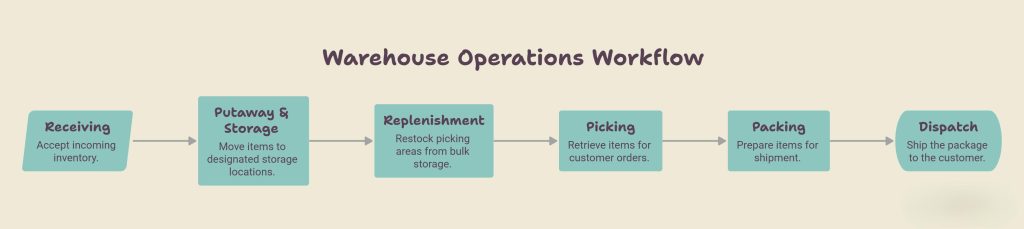
A WMS connects the major stages of warehouse activity into a single workflow.
Receiving → Putaway → Storage → Replenishment → Picking → Packing → Dispatch
At each stage, the system records inventory movements and provides tasks or information to warehouse users.
This creates a digital record of warehouse activity while giving managers greater visibility into inventory and operational performance. For businesses with multiple warehouses, high SKU volumes or complex fulfillment requirements, this centralized approach can make warehouse processes easier to control and scale.
WMS Integration With ERP and Other Systems
A warehouse is closely connected to purchasing, sales, logistics and customer operations. A WMS therefore needs to exchange information with the systems used across the business.
Common integrations include:
- ERP systems
- Ecommerce platforms
- Order management systems
- Transportation systems
- Supplier systems
- Customer portals
- Warehouse automation
- Business intelligence platforms
PALMS™ uses a service-oriented architecture that supports integration with sales, purchasing, logistics and third-party systems.
Why Choose PALMS™ Smart WMS?
PALMS™ Smart WMS is built to manage warehouse operations with real-time inventory visibility, order fulfillment, automation and data-driven reporting.
The platform supports warehouse processes across receiving, inventory, picking, dispatch and stock management. It also offers specialized capabilities for areas such as 3PL warehousing, cold storage, track and trace, warehouse analytics and warehouse automation.
Our PALMS™ WMS has served 500+ warehouses across 20+ countries, supporting businesses with digital warehouse management and connected supply chain operations.
Conclusion
A Warehouse Management System can help businesses gain better control over inventory, warehouse processes and order fulfillment. From improving inventory accuracy and warehouse productivity to reducing errors, optimizing space and supporting automation, the benefits extend across the complete warehouse operation.
Looking to improve warehouse efficiency with a smarter WMS? Explore PALMS™ Smart WMS or request a demo to see how it can support your warehouse operations.
Frequently Asked Questions
What are the main benefits of a Warehouse Management System?
The main benefits include improved inventory accuracy, real-time visibility, faster order fulfillment, higher warehouse productivity, better space utilization, fewer errors, lower operating costs and easier integration with warehouse technologies.
How does a WMS improve inventory accuracy?
A WMS records inventory movements throughout the warehouse and can use barcode scanning, RFID and handheld devices to validate products, quantities and locations. This helps reduce manual entry and inventory discrepancies.
Can a WMS reduce warehouse operating costs?
Yes. A WMS can help reduce costs by improving labor utilization, reducing warehouse errors, optimizing storage space and streamlining repetitive warehouse processes.
Can a WMS integrate with ERP software?
Yes. WMS platforms can integrate with ERP and other business systems to exchange information related to inventory, purchasing, sales orders, receiving and warehouse operations.
Can a WMS support warehouse automation?
Yes. A modern WMS can work with technologies such as barcode scanners, RFID, pick-to-light, put-to-light, conveyors, ASRS and Warehouse Control Systems. PALMS™ also provides WCS capabilities for integration with automated warehouse equipment.
